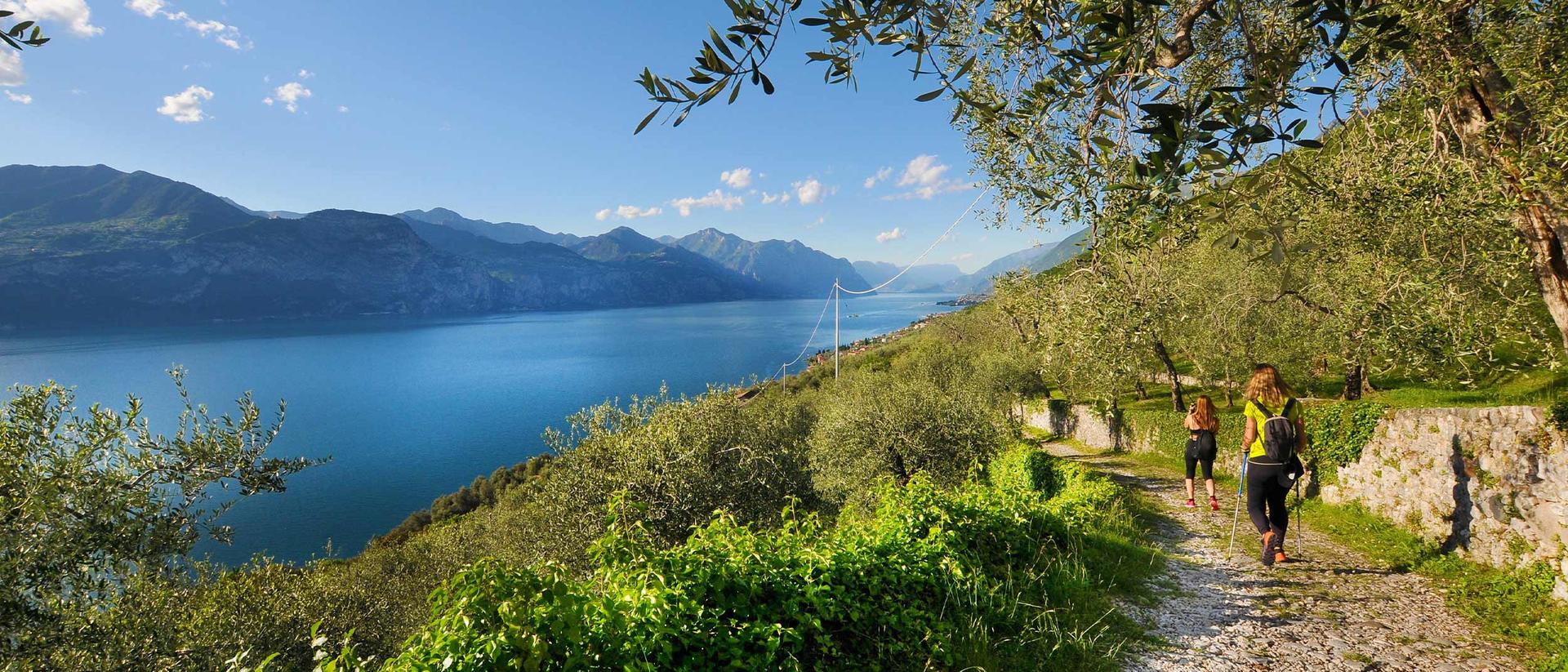
Cycling around Lake Garda, as a single unbroken loop hugging the shore, is not yet something you can do safely from start to finish. The western shore road burrows through a string of narrow tunnels, parts of the Verona shore still put you on the main road, and the cycleway meant to close the whole ring exists only in pieces.
You can still make the trip, and make it well, by treating it as a journey in stages. Over seven days, mixing train, ferry and cycling, you set off from Trento, drop down to the lake along the Adige, cross the northern basin, follow the Verona shore south and finish in the Mincio plain, between Mantua and Verona.
Can you actually cycle around Lake Garda?
It is the first question anyone asks looking at the map, and the honest answer is that you cannot ride the full perimeter on protected paths the whole way. The trouble spots are well known. The Lombardy shore, from Limone towards Salò, is one narrow tunnel after another. The Trentino stretch between Torbole and Malcesine forces you onto the main road for several kilometres, through dark tunnels and traffic.
This is why the ferry becomes part of the route rather than a fallback: it carries you past the dangerous sections and puts you back in the saddle where riding is a pleasure again. On the Verona shore, by contrast, much of the coast is already rideable in safety, and the few kilometres left on the open Gardesana are done with your lights on and a little care. Taken as a staged trip, the ride comes together.
When to go
The trip is at its best in spring, from April into May, and in autumn, from mid-September through October. The days are long, the olive groves and vineyards have their colour, and in the afternoon the light comes in low across the water. Temperatures hold up well on the short climb to Nago and on the open flats of the Mincio plain, where the heat of high summer becomes hard going. July and August are best left alone.
The seven days
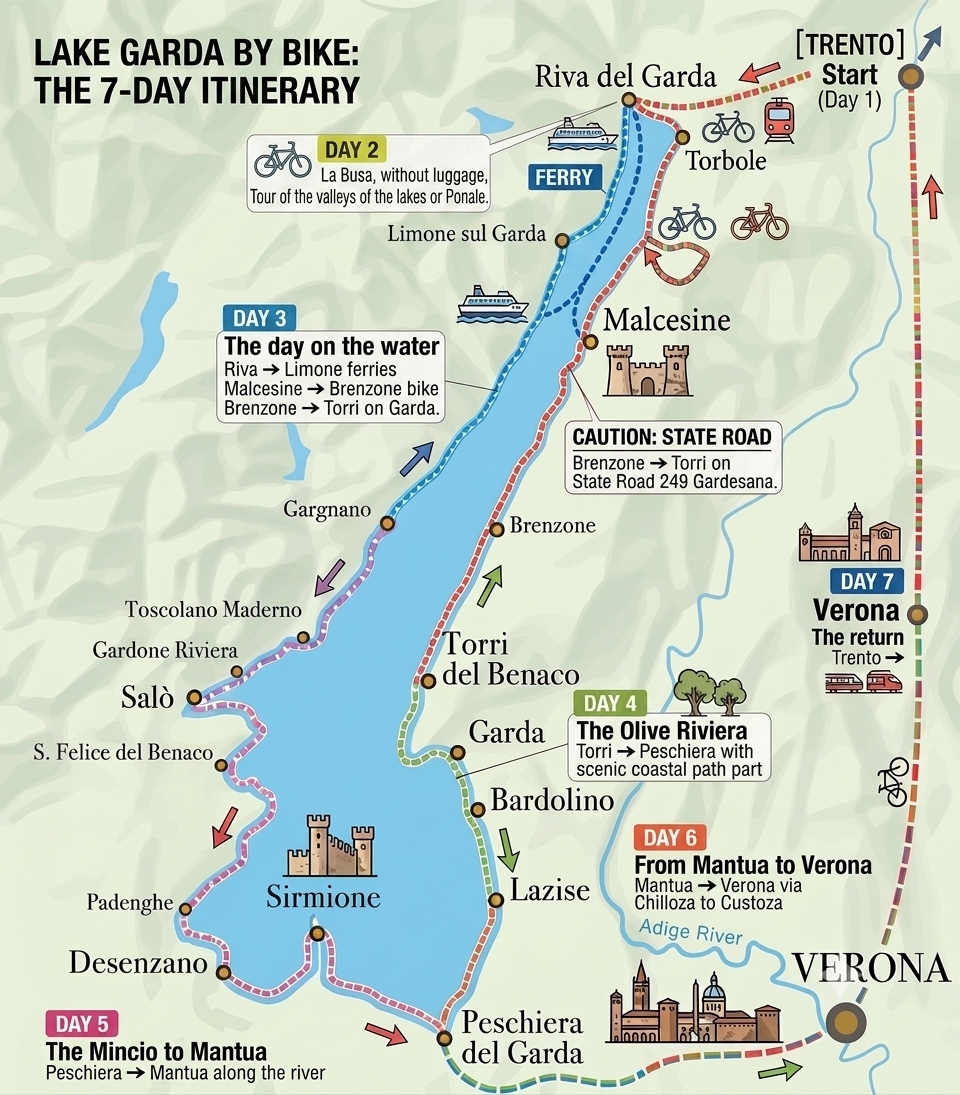
Day 1. From Trento to Riva along the Adige
Load your bike onto the train to Trento. Depending on when you arrive it is worth pausing in the city before you set off, as Trento repays a visit. Then pick up the Adige valley cycleway, surfaced and almost flat, following the river between apple orchards and the rock walls of the valley floor.
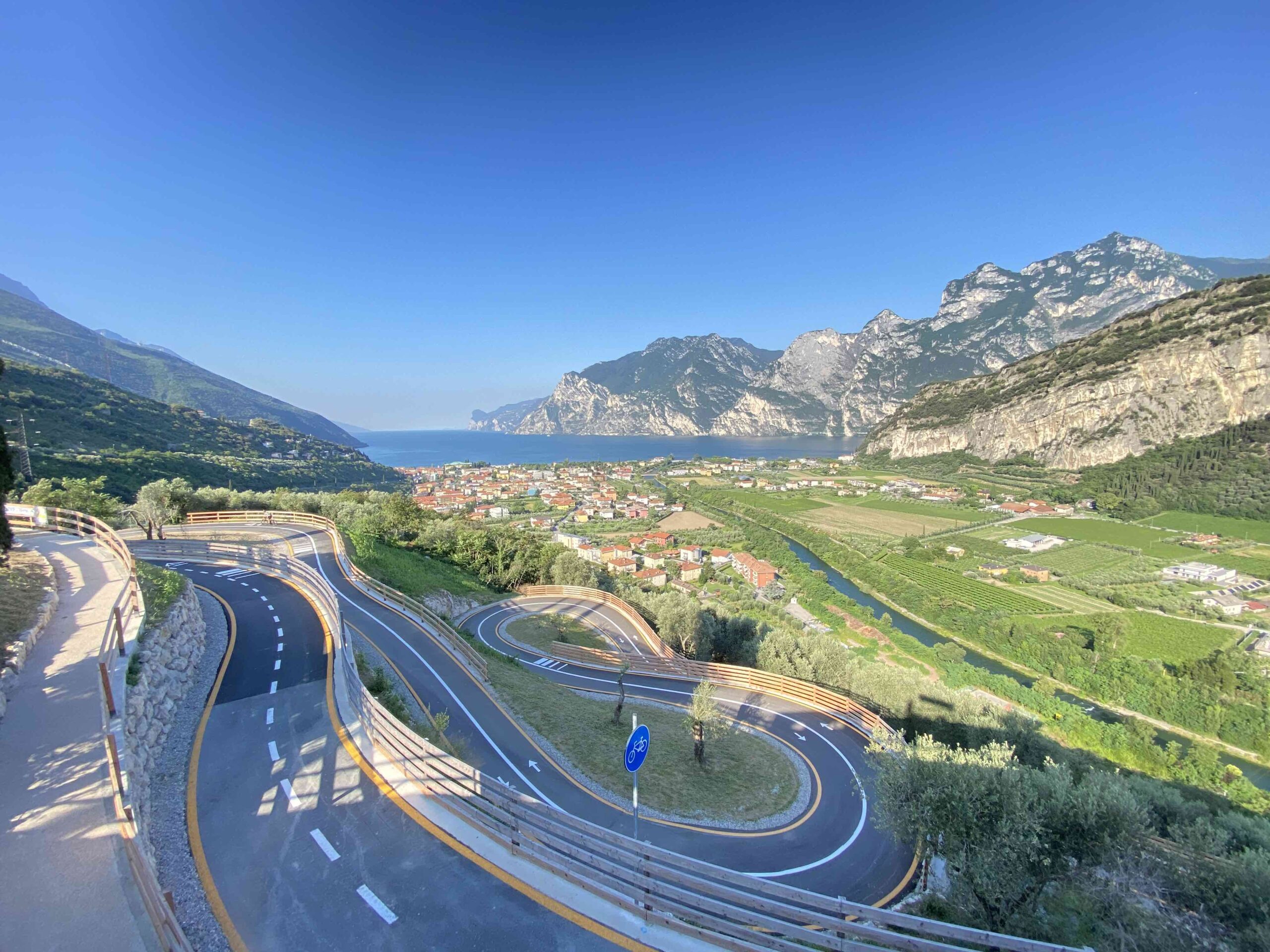
This is the same route that fills each summer with German cycle tourists heading south, and a stop at the Nomi bicigrill, a roadside cyclists’ café, is part of the ritual. After around fifty kilometres, near Mori, you leave the Adige and take on the one real climb of the trip, short, up to Nago.
At the fort the lake appears all at once at the foot of the basin, with Torbole and its sails scattered on the water once the Òra, the afternoon wind from the south, gets up. From there you drop down to Torbole and Riva, about three easy hours behind you. This is the first stage: here you choose where to stay in Riva del Garda.
Day 2. The Busa, without luggage
✨ Live Lake Garda: Unique Experiences Handpicked for You
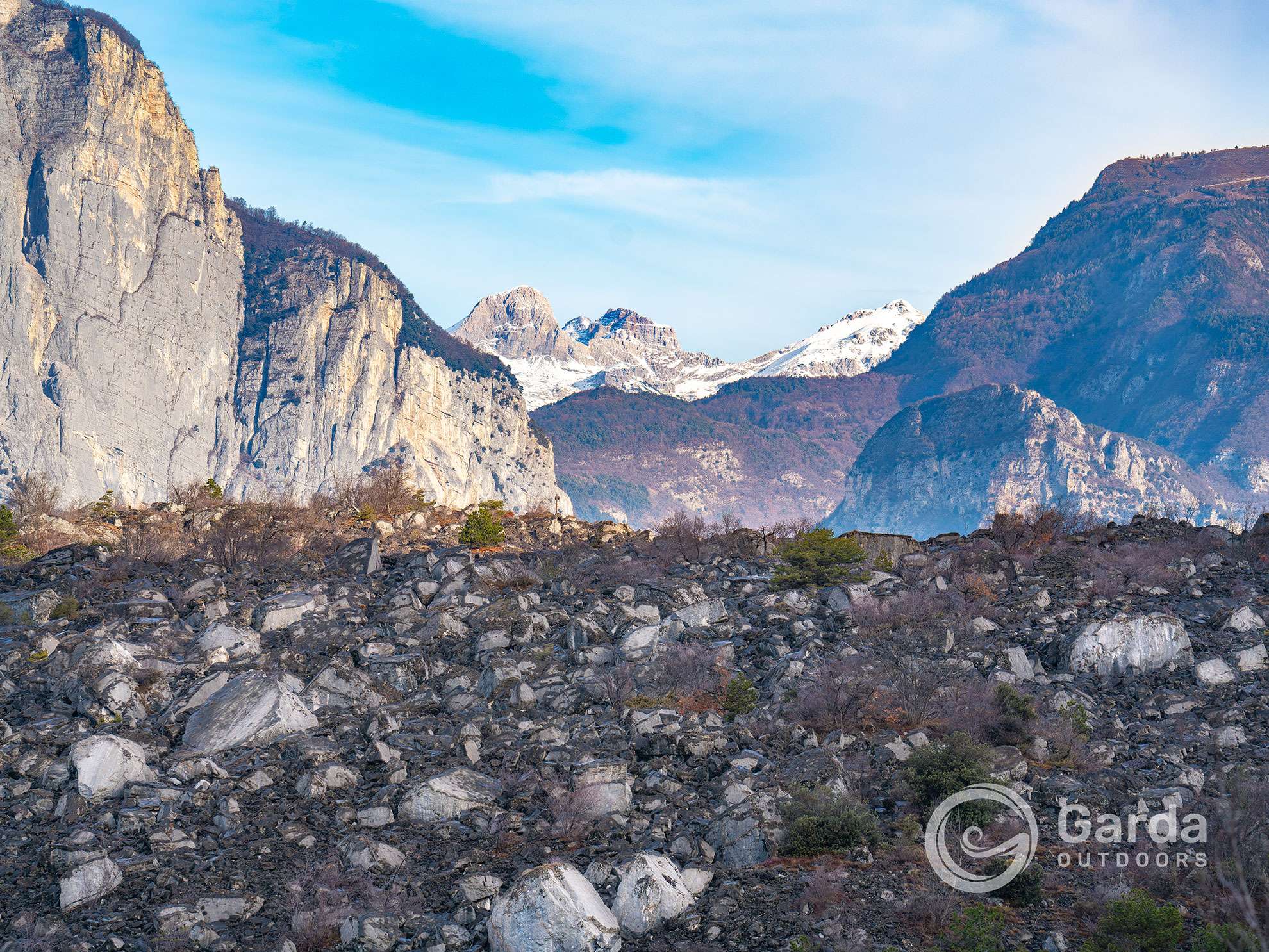
On the second day you leave your panniers at the hotel and ride light. One option is the Valle dei Laghi: climb towards Sarche to the lake of Toblino, with its castle on the water, carry on to Cavedine and cross the Marocche di Dro, a field of boulders that came down off the mountain thousands of years ago, before returning along the Sarche cycleway, surfaced throughout.
The alternative is the Ponale, the old gravel road cut into the cliff above Riva, now closed to cars, which climbs towards the Val di Ledro with the lake opening below you from one terrace to the next. Either way you sleep where you began.
Day 3. The day on the water
Here the lake becomes part of the route. Take the boat from Riva or Torbole across to Limone on the far shore: there is still no continuous cycle link between Riva and Limone, and the crossing is the sensible way past that stretch. Walk the village and follow the suspended cycle path, anchored to the cliff some fifty metres above the water, better done on foot with the bike beside you when it is busy.
Then take the ferry straight across the lake to Malcesine, below the Castello Scaligero where Goethe was taken for a spy while sketching it, with the cable car turning on its own axis as it climbs Monte Baldo. Before you set off again, look in at the castle, the Palazzo dei Capitani and the lanes of the old centre.
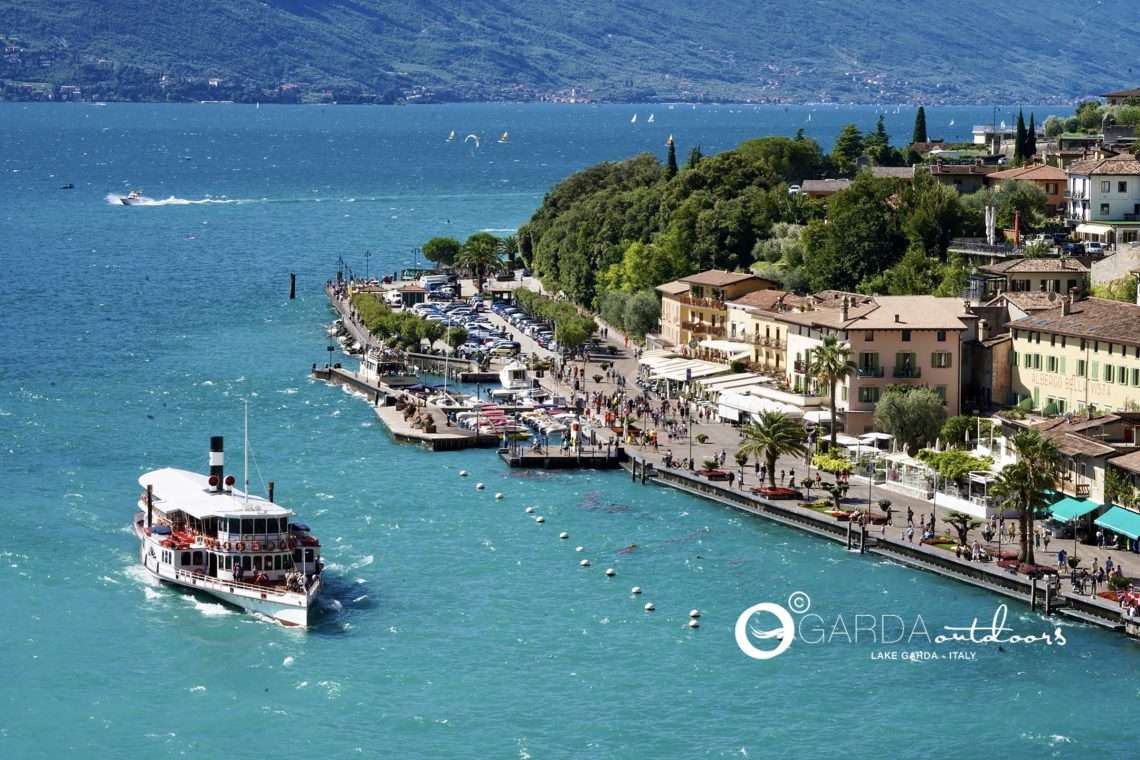
From the harbour you begin to work your way south. You pass the Val di Sogno, sheltered in its inlet, and Cassone, a small fishing harbour crossed by the Aril, which at only a few metres long lays claim to being the shortest river in the world.
You then ride through the small villages of Brenzone, and a couple of kilometres past Castelletto the cycle path ends: you continue on the main road, a flat stretch along the lake where the traffic moves slowly, though it calls for care. So you reach Pai di Sotto and, a little further, Torri del Benaco or Garda, where you spend the night.
The link between Torri and Garda also runs on the main road, to get round Punta San Vigilio.
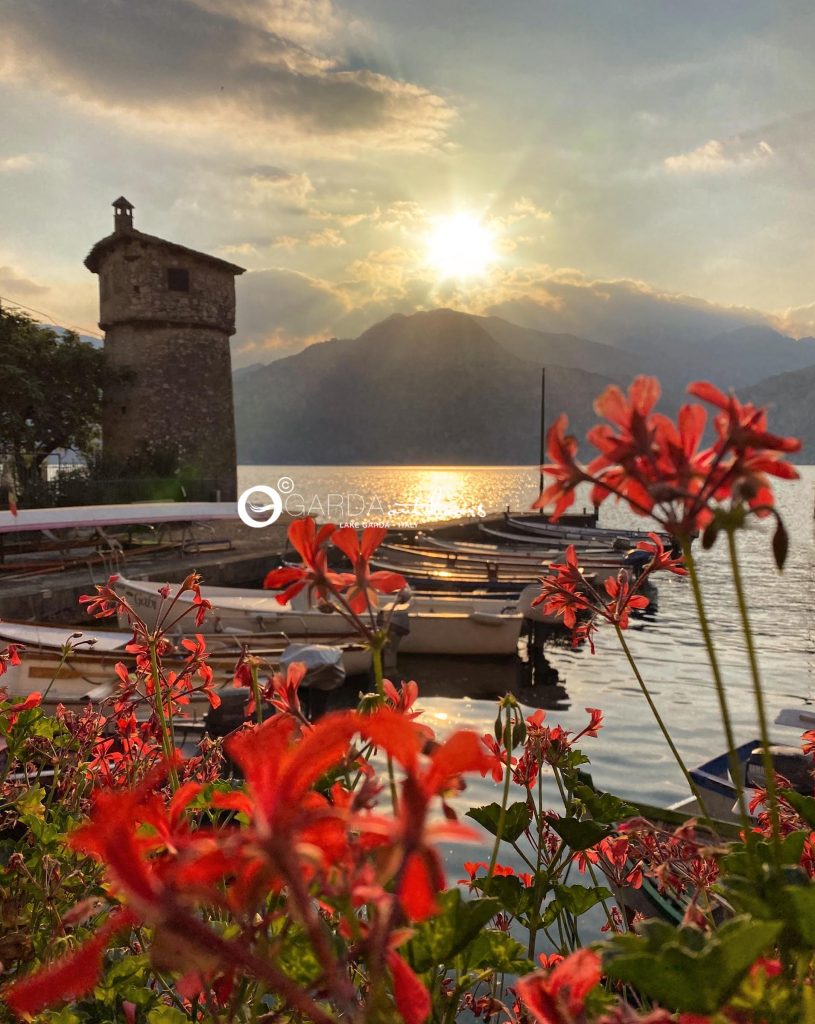
One detour is worth the time, and it is done on foot. Leave your luggage at the hotel in Torri and ride the two kilometres of hairpins up to Crero, a village of stone houses and narrow lanes that brings a corner of Provence to mind, looking out over the blue.
Leave the bike there and carry on along the senter de mes, the middle path, to the suspension bridge: a steel walkway around thirty metres long, hung some forty metres above the valley, leading across to Pai di Sopra.
Then you walk back for the bike. It is a couple of hours on foot among the olives and the woods, with the lake opening at intervals, and you can fit it in on the afternoon you arrive or the next morning before you leave.
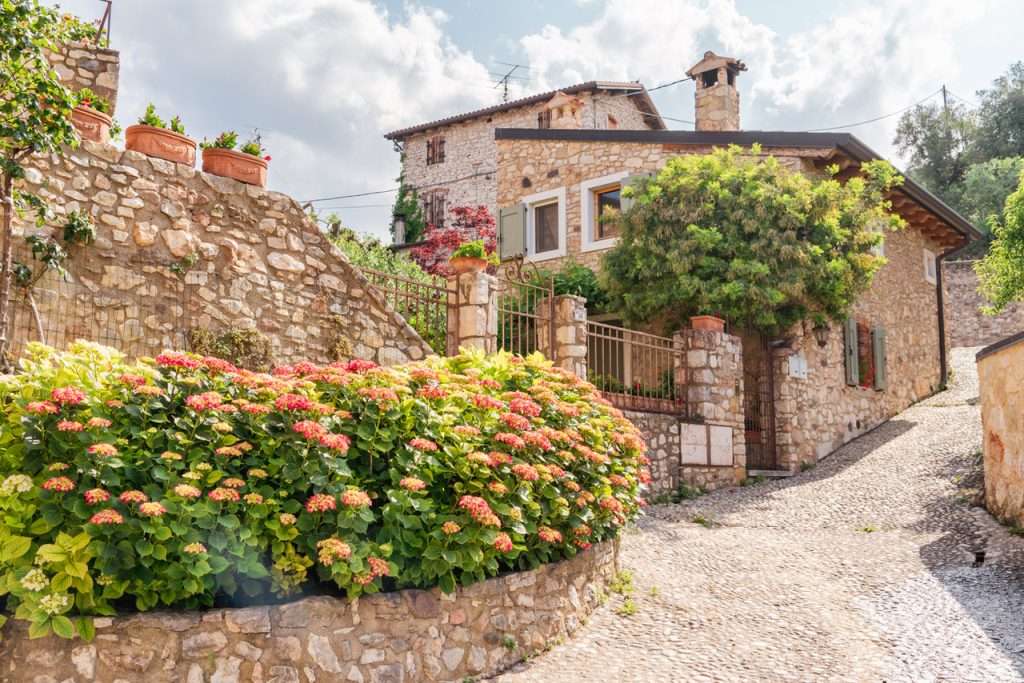
Day 4. The Riviera degli Olivi, the olive shore
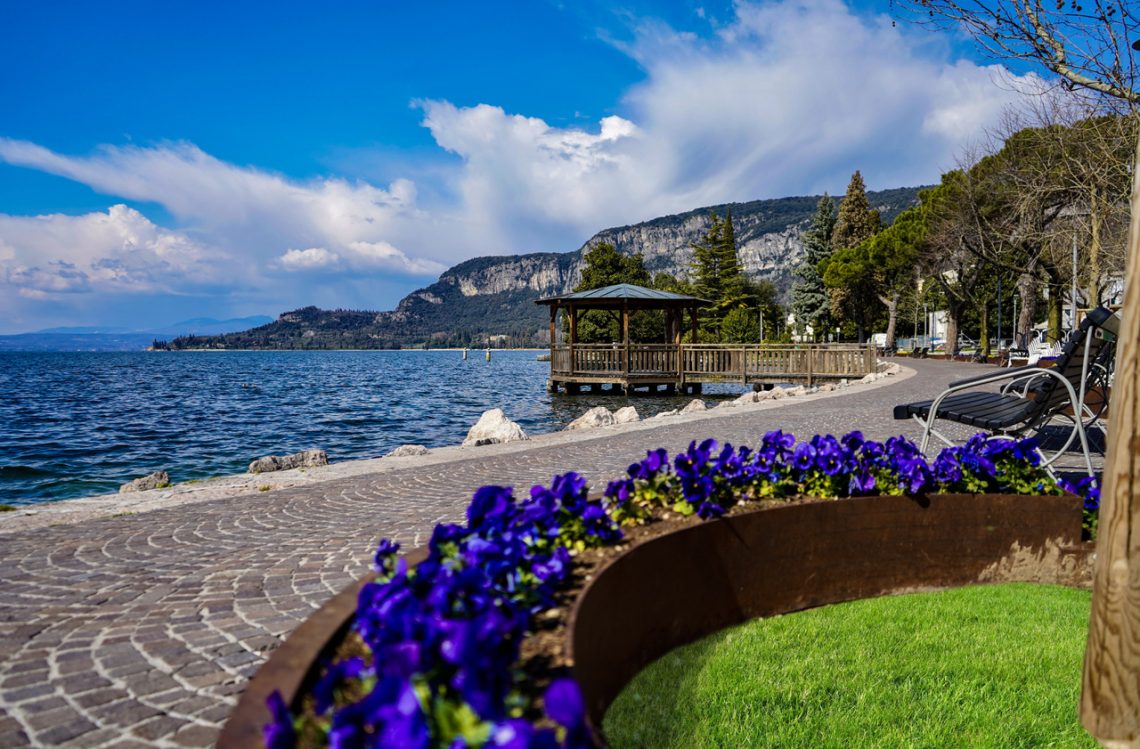
This is the gentlest stage, almost all of it on the lakeside path among the olive trees. From Torri del Benaco, with its Castello Scaligero and its lemon house, follow the shore to the bay of Punta San Vigilio, a spit of cypresses with an old inn by the water, then reach Garda beneath its Rocca and Bardolino, where the wine is made and where the timbers of a Bronze Age village still show through the lake bed.
A little further on is Lazise, closed within its walls and its Scaligero castle, with the Dogana Veneta, the old Venetian customs house, on the harbour: it was the first free comune in Italy. Another half hour in the saddle brings you into Peschiera, inside the Venetian fortifications that UNESCO has added to its list. It is a light day, made for taking the villages slowly: give yourself the time to stop. Night in Peschiera or Lazise.
Day 5. The Mincio to Mantua
From Peschiera you pick up the Mincio cycleway, laid on the bed of a railway that until the 1960s carried holidaymakers from the lake to the plain. It runs flat between fields of wheat and poppies, along the bends of the river, to Borghetto sul Mincio, a hamlet of Valeggio among the loveliest villages in Italy: houses and watermills built at the water’s edge, and above them the long Visconti bridge barring the valley.
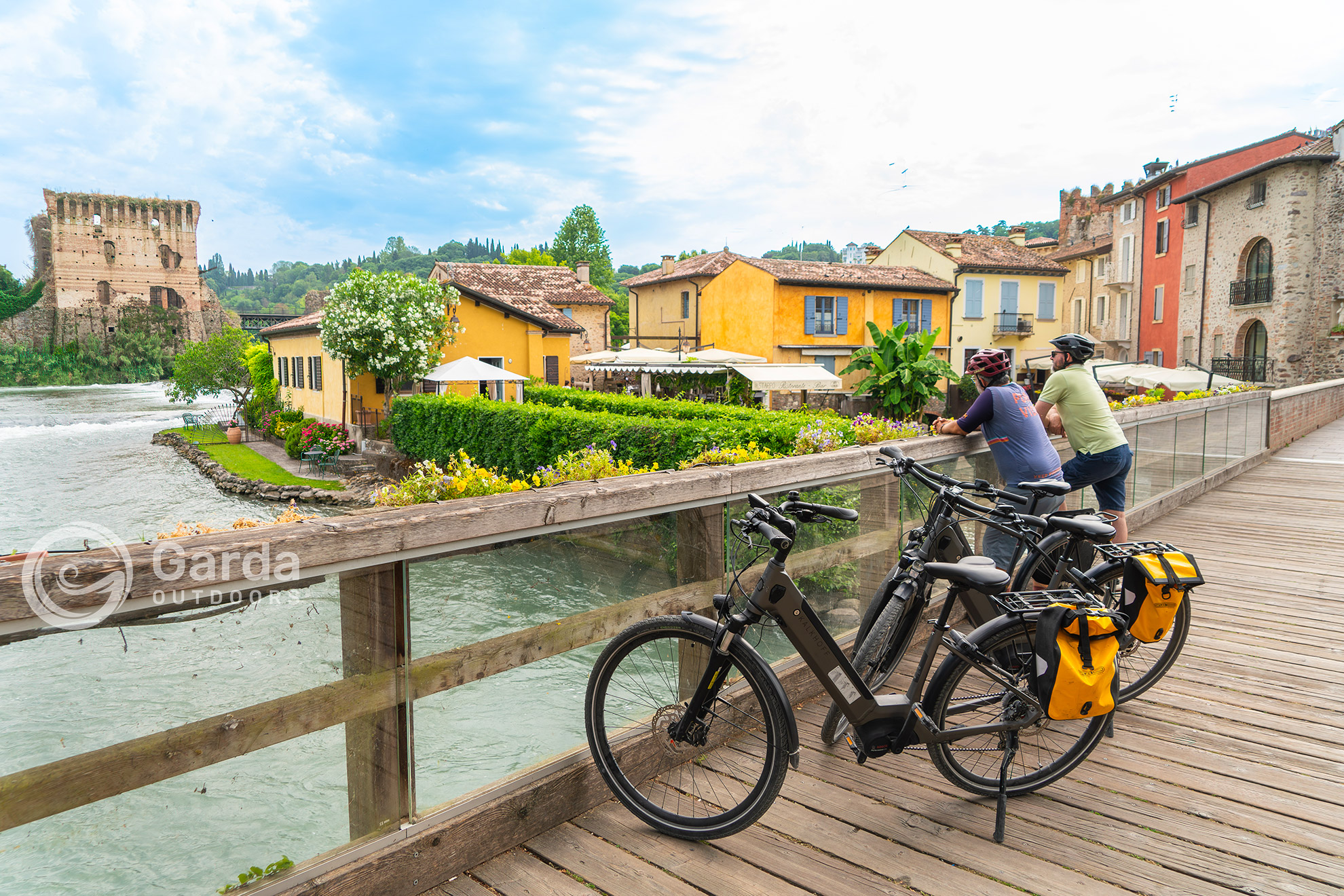
Many stop here for the tortellini of Valeggio, the nodo d’amore or love knot. Back on the river, a couple of hours through the Mincio park bring you to the bridge into Mantua, carried over the Lago Superiore: the Gonzaga city stands ringed by its three lakes, with the Palazzo Ducale and Mantegna’s frescoes and, just outside, Giulio Romano’s Palazzo Te. It is a city rich in history and art, where you eat and drink well: Mantua feeds body and soul alike.
Day 6. From Mantua to Verona
You ride back up the Mincio one last time, past Borghetto and Valeggio, then leave the river for the morainic hills of Custoza, among the vineyards and the fields where the nineteenth century fought its battles: the ossuaries of Custoza and San Martino, not far off, keep their memory.
From there you drop towards Verona and enter the city at Piazza Bra, in front of the Roman Arena. It is around fifty kilometres, almost all flat, leaving you the afternoon for the centre, Juliet’s house, Castelvecchio and the bends of the Adige. With a spare day you can turn off into the Valpolicella, its villas and its Amarone. Night in Verona.
Day 7. The way back
You load the bike onto the regional train one last time and ride back up the Adige valley to Trento, where you began: the circle closes without having to retrace by bike everything you have already seen. If your legs are still willing, you can instead ride back from Verona up the Adige valley: you pass Rivoli, where Napoleon defeated the Austrians in the battle that gave Paris its Rue de Rivoli, cross the vineyards of the Vallagarina and visit the castle of Avio before returning to Trento. It is a long stage, worth taking on only if you are fit.
Logistics: train, ferry, hire
Bikes travel on the regional trains for a small supplement, and on some lines it is worth booking a space. The lake boats and ferries carry bikes, but timetables and routes change with the season, so always check before you travel on the Navigarda website. In the Mincio area, alongside the train, there is a bookable bici-bus service, useful for getting back without repeating the same road. If you are not bringing your own bike, you will find city bikes and e-bikes for hire at the stops along the way.
Frequently asked questions
Can you cycle all the way around Lake Garda?
Not as a continuous, protected loop: some stretches, above all on the Lombardy shore and between Torbole and Malcesine, are still on the main road with tunnels. The circuit is made by joining the existing cycleways and using the ferry to skip the dangerous sections.
How many days do you need?
To cross the whole territory at a comfortable pace, from Trento to Mantua and Verona, allow a week. With less time you can stay on the lake and finish at Peschiera.
Is it suitable for families?
The individual flat cycleways, such as the Mincio or the lakeside paths on the Verona shore, are fine with children. The full staged journey, at around fifty kilometres a day for several days and with some stretches on the main road, is meant for those who ride regularly or use an e-bike.
Do you need an e-bike?
Not necessarily. The route is nearly all flat, with a single short climb up to Nago on the first day. An e-bike does make the longer stages and the day in the Alto Garda more comfortable.
Which way round should you ride it?
North to south, starting from Trento. You take the short opening climb on fresh legs, then head down towards the plain, with the convenience of an easy train back from Verona.